🐊 Drain the Data Swamp, Dig the Data Lake Right
🐊 “We’ll Add Structure Later”
— a Eulogy and a Resurrection
“A beginning is the time for taking the most delicate care that the balances are correct.” — Frank Herbert, Dune (1965)
🎣 The Lake That Wasn’t
You need a number from the 2019 cohort — something Finance swears got loaded “back when we set up the lake.” Forty minutes and a lot of aws s3 ls later, you’re spelunking through raw/2019/, and here’s the haul:
events.csvevents_final.csvevents_final_v2_REAL.csv
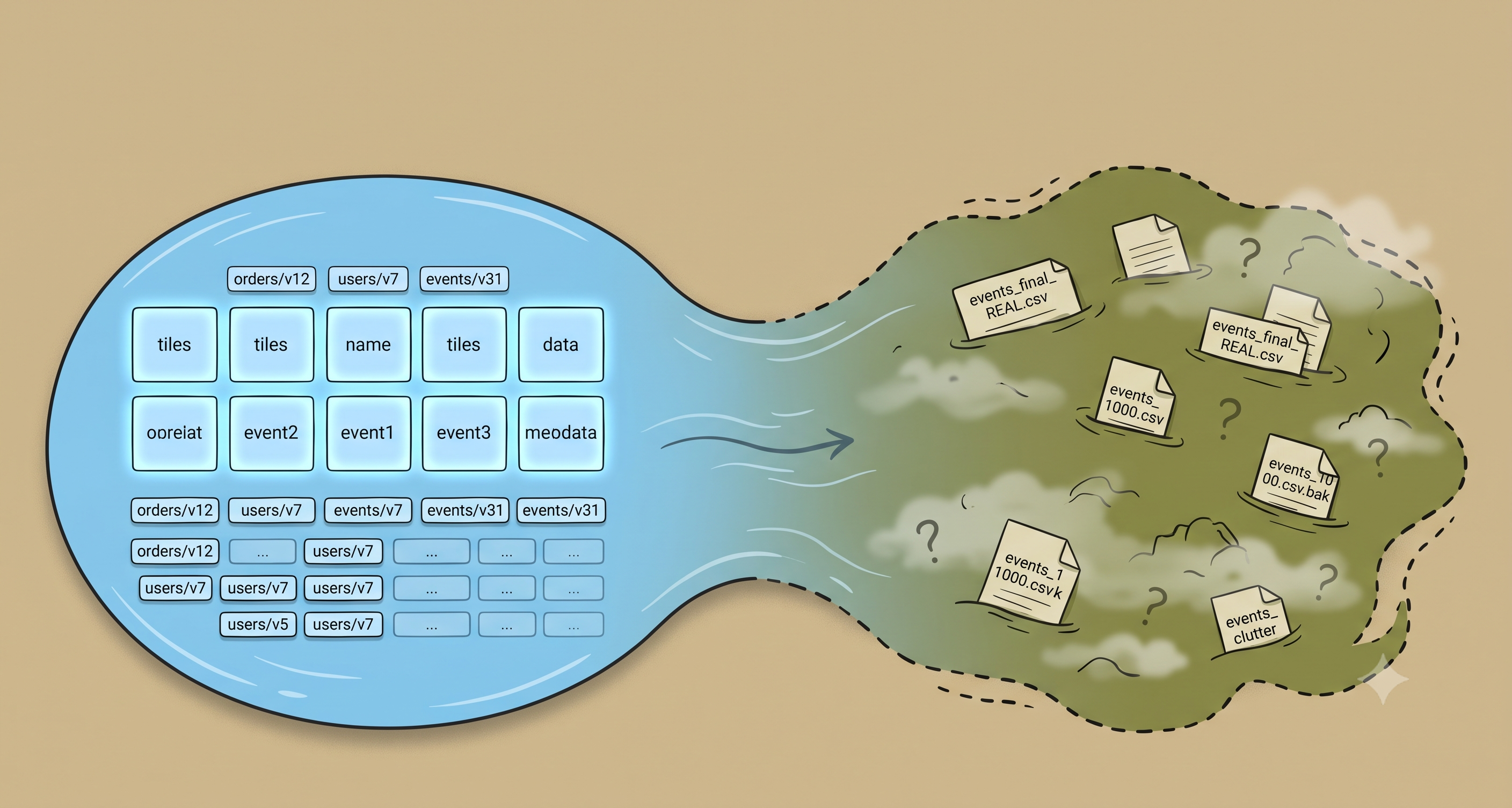
Three files. No trustworthy timestamps, no record of which job wrote which, no idea whether the schema drifted between them. Whoever named the third one left the company in 2021. The lake your team spent two years filling isn’t a lake. It’s a swamp. 🦠
| //: # ( | —— | ——- | ) |
| //: # ( | 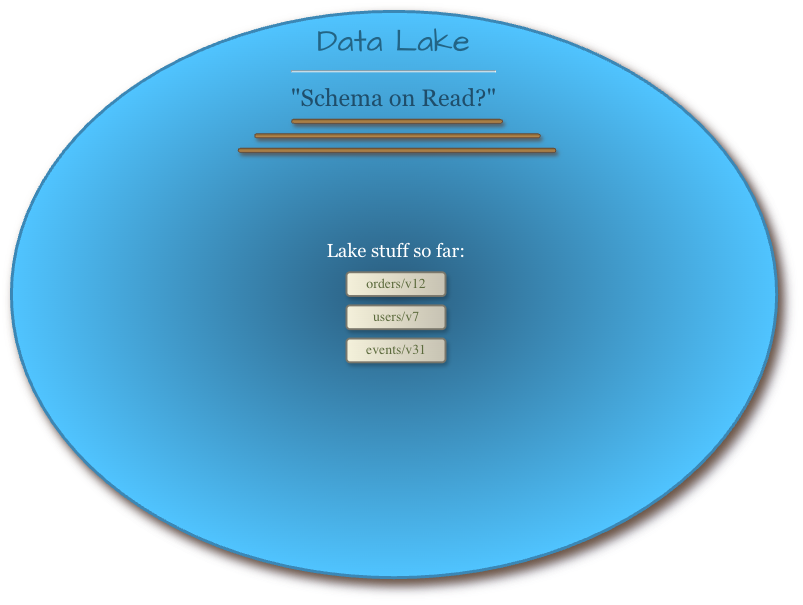 |  | ) |


- “Data lake” was always a slightly optimistic name. A lake is clear, contained, swimmable.
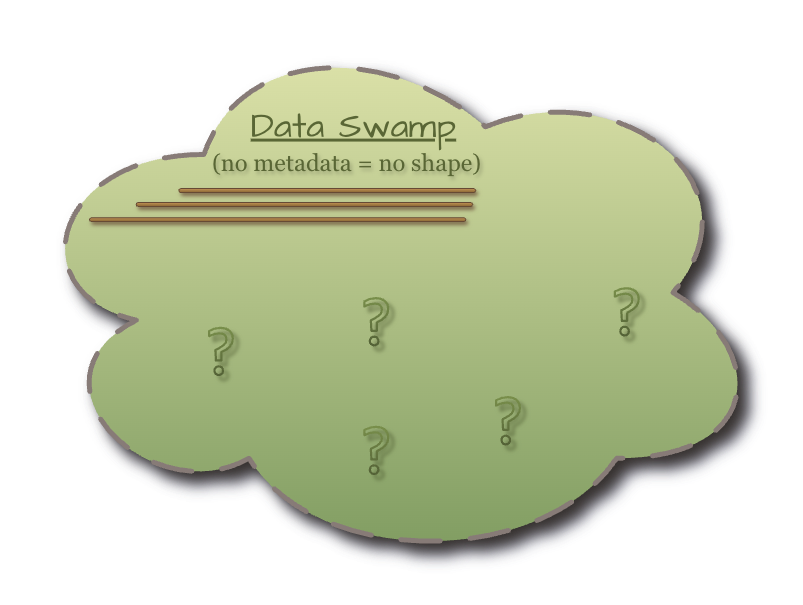
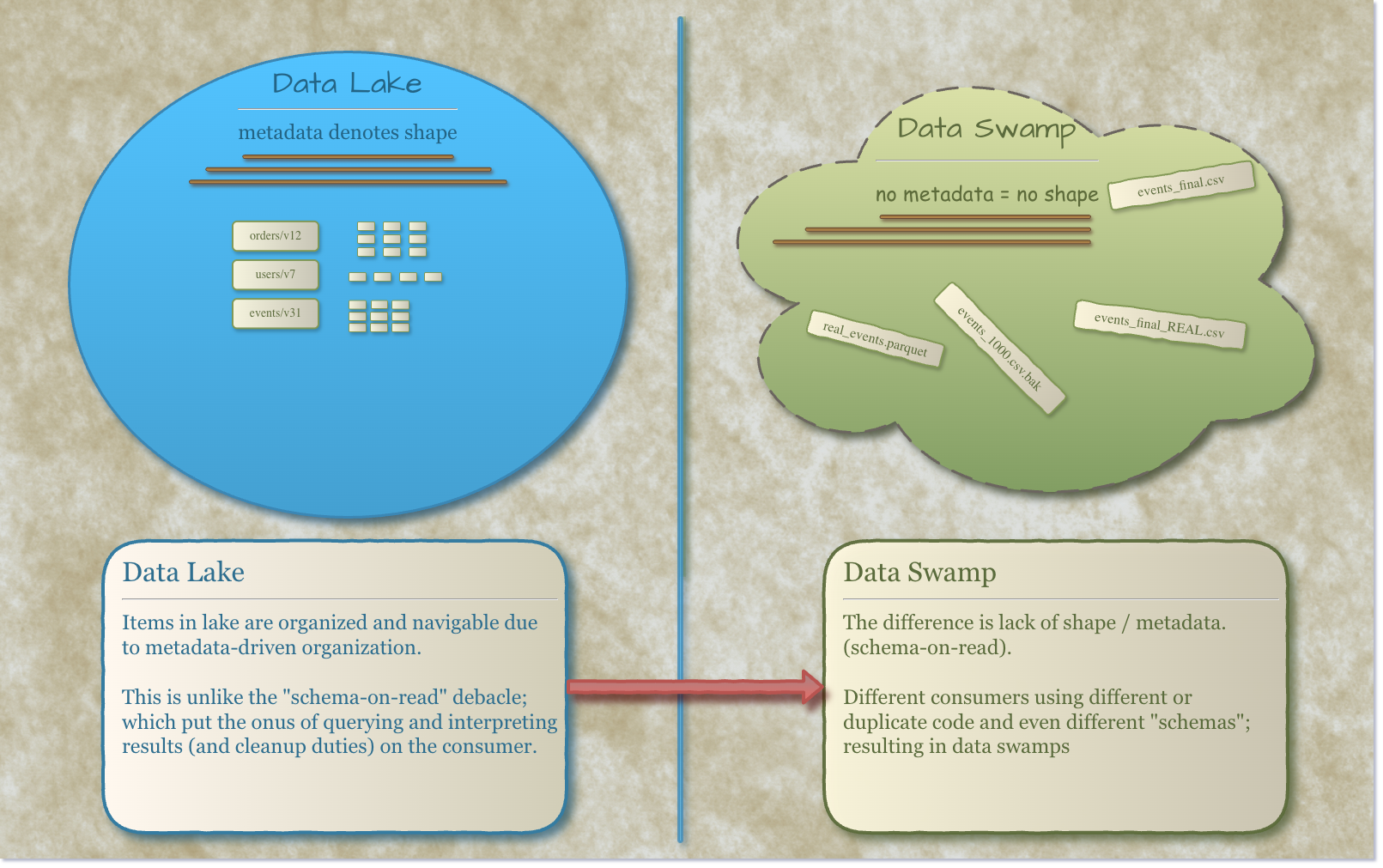
- A swamp is where things wander in, sink, and are never reliably seen again. And here’s the uncomfortable bit: the difference between the two isn’t the water. Same files, same bucket, same Parquet, same monthly bill. It’s whether anything gives the water a shape.
That shape has a name: an open table format — Apache Iceberg, Delta Lake, or Apache Hudi. One metadata layer is the whole difference between the shapeless blob above and a lake with an actual shoreline.
A data lake without a table format is a swamp. A data lake with one is a warehouse that forgot it was supposed to be expensive.
So that’s the tour: how that layer works, what it hands back to you, and the handful of times you’re honestly fine without it.
🧊 The Missing Spine: Open Table Formats
The whole thing turns on one sentence: a pile of Parquet files isn’t a table. It’s a pile of files that happen to share columns and a vague hope.
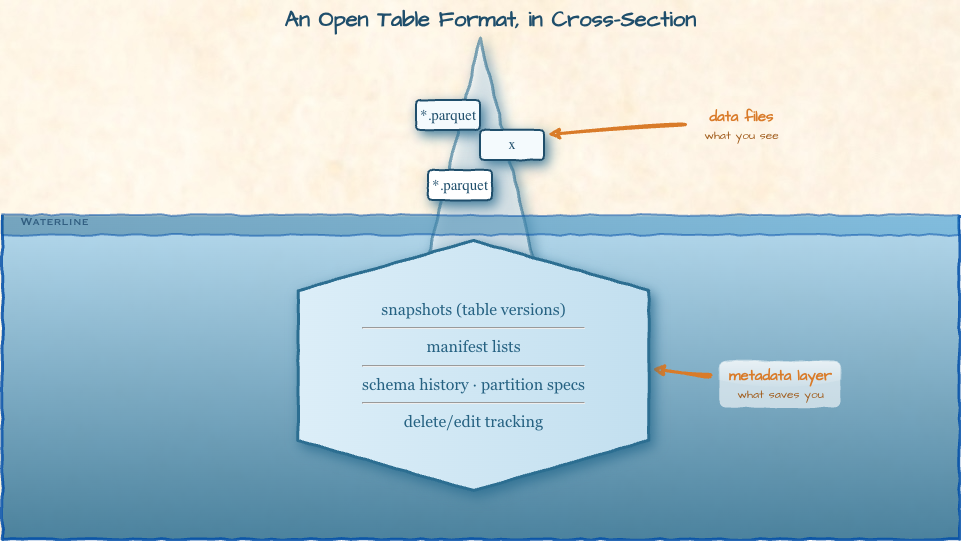
What turns that pile into a table is a metadata layer sitting over the files, keeping receipts on:
- which files belong to which version of the table
- the schema at each version
- how the thing is partitioned
- what’s been deleted, and when
That layer is the table format. It’s the spine the lake was always missing — the thing that finally gives the water a shape.
Dijkstra put it best in a 1972 lecture: “the purpose of abstraction is not to be vague, but to create a new semantic level at which we can be absolutely precise.” A table format does exactly that for a heap of files. It’s the level at which “the table” becomes a real, queryable thing instead of a rumor.
🗂️ A Quick Taxonomy
Four terms get used interchangeably in every architecture meeting. They are not interchangeable:
- Data Lake — one store for all your data, structured or not, sitting in cheap object storage and open file formats, queried by whatever engine you point at it. Schema deferred to read time. The pitch: dump now, structure later.
- Data Swamp — what a lake becomes when nothing tracks structure, versioning, or provenance. Every byte is still sitting right there. You just can’t tell what any of it is, who wrote it, or whether you’d stake the quarterly number on it. A lake nobody can swim in.
- Data Warehouse — the governed, transactional thing the lake was rebelling against: schemas enforced on write, fast SQL, correctness baked in. You pay for all of it in money, rigidity, and lock-in.
- Table Format / Lakehouse — the spine above, and the name for a lake that has one. More on the lakehouse shortly.
🏛️ Why Not Just Use a Data Warehouse?
Somebody always asks this right about here, usually the person who signs the invoice.
A warehouse — Snowflake, BigQuery, Redshift — already hands you schemas, transactions, and fast SQL. If structure is the goal, why build a lake at all?
Three reasons teams keep reaching past the warehouse:
- Cost & coupling — Classic warehouses weld storage to compute and charge a premium for both. A lake pries them apart: data sits in cheap object storage, and any engine — Spark, Trino, Athena, DuckDB — can read it.
- Shape of the data — Warehouses want tidy rows and columns, thank you. Lakes happily swallow JSON, Parquet, images, audio, log dumps — the messy, semi-structured stuff modern ML actually runs on.
- Open formats — Your data is plain files you can read with anything, today or in ten years. No vendor’s proprietary internals holding your history hostage.
So no, the lake wasn’t a mistake. It exists for genuinely good reasons.
The Catch
Here’s what nobody puts on the slide: a warehouse was quietly doing four jobs for you — enforcing schemas, running transactions, tracking what changed when, and keeping one version of the truth. Dump raw files into S3 and all four jobs simply… stop getting done. Nobody sends a notice.
You kept the cheap, open, flexible part. You threw out the part that kept everyone sane.
Table formats are how you get that part back — without giving up the lake. But first: how did we all end up in the swamp?
🏞️ The Promise
Rewind to the pitch. It was intoxicating.
The Solution: “Schema-on-Read”. Stop arguing about column types in a two-hour planning meeting. Stop sizing clusters. Land the data now, in whatever shape it arrives, and defer all that fussy structure until query time. Storage is cheap, flexibility is infinite, and nobody has to model anything up front.
For a glorious while, it works exactly as advertised. Then “later” arrives.
The Reality
“Later,” it turns out, is where lakes go to die. Schema-on-read failed for a very human reason: it never eliminated the cleanup work — it just shifted it, off the few who produce the data and onto the many who consume it. Nobody enforced anything at the front door, so the lake became a dumping ground for low-quality, undocumented bytes. The swamp wasn’t an accident; it was the default.
With nothing tracking the state of your data, the bill comes due all at once — four capabilities you quietly lost:
- ❌ No ACID — Two jobs write the same table at once; a reader catches it mid-write and sees a table that never logically existed.
- ❌ No schema evolution — Adding one column means rewriting every file, or silently shipping mismatched schemas that break readers downstream.
- ❌ No time travel — Overwrite a file and the prior version is gone. No “what did this look like last Tuesday.”
- ❌ No safe deletes — A single GDPR request turns into rewriting whole partitions by hand.
…and a fifth wound running underneath all four:
- ❌ No provenance — No record of which job wrote which file, when.
events_final_v2_REAL.csvis a provenance problem wearing a costume.
These aren’t bugs you fix. They’re capabilities the lake never had — and they’re exactly what the metadata spine restores.
🌐 The Four Superpowers
“Life itself was a grand chemical improvisation that began with the simplest replicators and grew and collapsed and grew again. Catastrophe was just one part of what always happened. It was a prelude to what came next.”
— James S.A. Corey, Caliban’s War (2012)
Add that metadata layer, and four capabilities you thought required a warehouse come flooding back.
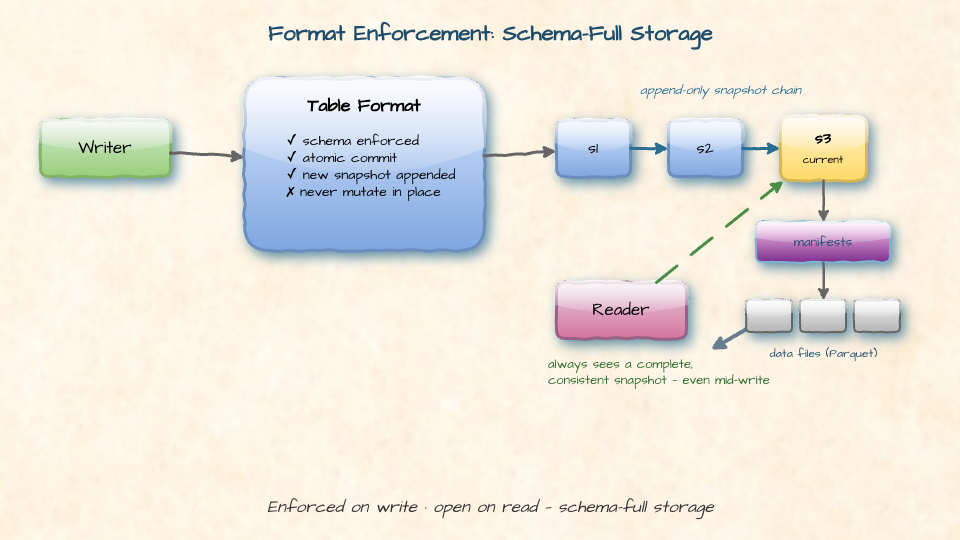
- ⚛️ ACID Transactions — Snapshot isolation, finally. Writers stop corrupting each other, and readers always see a complete, consistent version of the table — even mid-write. “The report ran during the load” stops being a root cause.
- 🔧 Schema Evolution — Add, drop, or rename columns without rewriting a single data file; old rows return
nullfor new columns. The schema lives in the metadata, not in the bytes — so evolving it is a bookkeeping change, not a migration you schedule around a long weekend. - 🕰️ Time Travel — Query the table as of any past snapshot or timestamp. Old versions don’t vanish — they’re just earlier entries in the log. (This one earns a whole section of its own below.)
- ✏️ Safe Upserts & Deletes —
MERGEandDELETEthat touch only what they must, instead of bulldozing whole partitions. That GDPR request? One statement.
The Mechanics
All four fall out of one design choice, and it’s almost boringly simple. Every write appends a new snapshot pointing at a set of manifests, which list the data files for that version. Nothing is ever mutated in place — you only ever append. Readers pin to a snapshot and stay consistent; writers never stomp on them. It’s git for your table: commits, history, and all.
The bonus fifth capability comes free with the receipts. That append-only log is provenance — a standing record of which write produced which files, and when. events_final_v2_REAL.csv never happens again, because nobody ever needs to invent it.
📜 Schema-on-Read Was a False Choice
Remember “The Solution” from a few sections back? Time to come clean about it.
We were sold a binary:
- Schema-on-write — rigid, governed, correct. The warehouse.
- Schema-on-read — flexible, chaotic, cheap. The lake.
Pick your poison and live with the tradeoff.
Except it was a false binary the whole time. Table formats quietly introduced a third option — schema-in-metadata: the schema is enforced on write and lives in the metadata, but the files stay open and the compute stays decoupled. Schema-on-write governance with schema-on-read flexibility. You were never actually choosing between rigid and chaotic. You were choosing between having metadata and not having it.
🆚 Iceberg vs Delta vs Hudi
Three formats, same mission, three very different personalities.
- Apache Iceberg — Netflix (2017; open-sourced 2018)
- Strength: Vendor-neutral; read by Athena, Spark, Trino, Snowflake, BigQuery, DuckDB; strong schema & partition evolution
- Watch out for: Some tooling still maturing; metadata needs periodic compaction
- Delta Lake — Databricks (open-sourced 2019)
- Strength: Mature; superb inside Databricks/Spark; strong ML tooling
- Watch out for: Historically Spark-centric
- Apache Hudi — Uber (2016)
- Strength: Built for high-frequency upserts & CDC; record-level indexing
- Watch out for: More operational complexity
Pick one in thirty seconds:
- Want vendor neutrality and the broadest engine support → Iceberg.
- Already living inside Databricks → Delta, and don’t overthink it.
- Drowning in high-frequency upserts or CDC → Hudi earns its complexity.
The Lakehouse
Put any of these on top of your lake and you’ve built what Databricks popularized as the lakehouse — a lake that behaves like a database. Cheap, open storage plus warehouse-grade correctness. The name is marketing; the capability is real.
🕰️ The Time-Travel Party Trick
Time travel sounds like a gimmick — until the Tuesday it saves your job.
- A dashboard number looks wrong → diff today’s snapshot against yesterday’s.
- An auditor asks what a table held on some date in 2023 → query it as of that timestamp.
- A bad batch job lands at 3am → roll back to the snapshot before it ran.
- A model needs reproducible training data → pin it to a snapshot ID.
None of this required planning ahead. The format was keeping the history whether you asked it to or not.
⚖️ When You Don’t Need a Spine
Honest moment: a table format isn’t free. Metadata needs occasional compaction, there’s a learning curve, and you’ve added one more layer to reason about at 2am. Sometimes plain Parquet in a folder really is the right answer:
- the data is clean on arrival, read once, by a single consumer
- it’s a throwaway export, a one-off analysis, a staging hop
- nobody will ever ask “what did this look like last month” — and be honest with yourself about ever
The spine earns its keep the moment you have messy input or more than one consumer. Below that bar, it’s just ceremony.
🗝️ Key Takeaways
- A data lake is just cheap object storage with excellent PR — what makes it trustworthy is a table format layered on top.
- Lakes silt into swamps because raw files have no ACID, no schema history, no time travel, no safe deletes — plus no provenance. A table format gives all four back, and provenance for free.
- “Schema-on-read vs schema-on-write” was a false binary — schema-in-metadata is the third option: governed and flexible.
- Iceberg for vendor-neutral breadth, Delta inside Databricks, Hudi for high-frequency upserts/CDC.
- Skip the spine only when data is clean-on-arrival, read once, by a single consumer. Everything else earns it.
“We can only see a short distance ahead, but we can see plenty there that needs to be done.”
— Alan Turing, Computing Machinery and Intelligence (1950)
Next in the series: once your lake has a spine, the 🥇 Medallion Pattern is how you organize trust on top of it.
📚 References
- James Dixon (Pentaho) — credited with coining data lake (2010)
- Ryan Blue & Dan Weeks (Netflix) — Apache Iceberg (2017; open-sourced 2018)
- Databricks — Delta Lake (open-sourced 2019) and the lakehouse framing
- Uber — Apache Hudi (2016)
- Edsger W. Dijkstra — Advanced Course on Computer Systems Architecture (EWD 356), Grenoble, December 1972
- Maxime Beauchemin — Functional Data Engineering (2018)
- Pat Helland — Immutability Changes Everything (CIDR 2015)
- Martin Kleppmann — Designing Data-Intensive Applications (2017)
- Frank Herbert — Dune (1965)
- Douglas Adams — The Hitchhiker’s Guide to the Galaxy (1979)
- James S.A. Corey — Caliban’s War (The Expanse, 2012)
- Alan Turing — Computing Machinery and Intelligence (1950)