📐 The Hidden Geometry of Software Coupling (Part 1)
📊 Part 1 — The Metrics That Predict Architectural Failure

📃 Introduction
Software engineers love to talk about architecture in qualitative terms.
- “This module feels tightly coupled”
- “That dependency seems risky”
- “This design is flexible”
But beneath those instincts lies something far more concrete
- 🏗 The structure of software systems can be measured
- 🏛️ Architectural problems can be predicted and addressed long before production failures reveal them.
- 🕰 The formulas behind these metrics have been around since the 1990s
- 🤖 They require no machine learning
- 🧮 Just counting (…and occasionally a little division)
🗿 The Architecture that was “pretty good”… until it opened a hellmouth 👹
For the first six months, even a year, everything felt fast. Our Ruby-on-Rails application was humming along and new features were added daily
- ⏲ Features shipped quickly
- 🐞 Bug fixes took hours, not days
- 🧑💻 Engineers felt productive
Then, something strange started happening; it began to shift:
- ⏳ A simple change began taking longer
- 🔗 A feature that should have been isolated to one component suddenly required edits across seemingly-unrelated code; models, controllers, helpers, serializers, background jobs, etc.
Then the real symptoms appeared:
- 🧟 Engineers no longer felt productive
- 👥 New engineers joined the team and couldn’t make heads or tails of the system.
- ⛓️ Bug fixes triggered unrelated failures.
- 🐞🐞🐞 A “small refactor” broke three features nobody expected to be connected.
- 🔥 Every change started to feel dangerous.
It’s a simple complex system. Because it’s simple, it’s prone to cascades, and because it’s complex, you can’t predict what’s going to fail. Or how. – “The Expanse”
⛓️ Architecture and Coupling
Eventually they hired an architect, who spent some time with the codebases and running various tools
Your problem isn’t Rails. Your problem is coupling.
All the software engineers had heard of this, of course, but thought of it as a qualitative measurement. It may have come up a few times since, but had never been exactly quantified. Now here it is in the real world.
The application had quietly evolved into something infamous:
🏢 A Tightly Coupled Monolith
Note: Coupling can still be a huge problem even if the software in question is not a monolith
When software is tightly coupled
- A change almost anywhere could trigger side effects somewhere else
- Features that should have touched one module required edits across five
- Bug fixes became archaeology
📏 And the surprising part?
- These structural problems weren’t mysterious
- They were measurable and preventable
📊 Coupling Metrics

📐 The Two Numbers That Explain Most Architecture
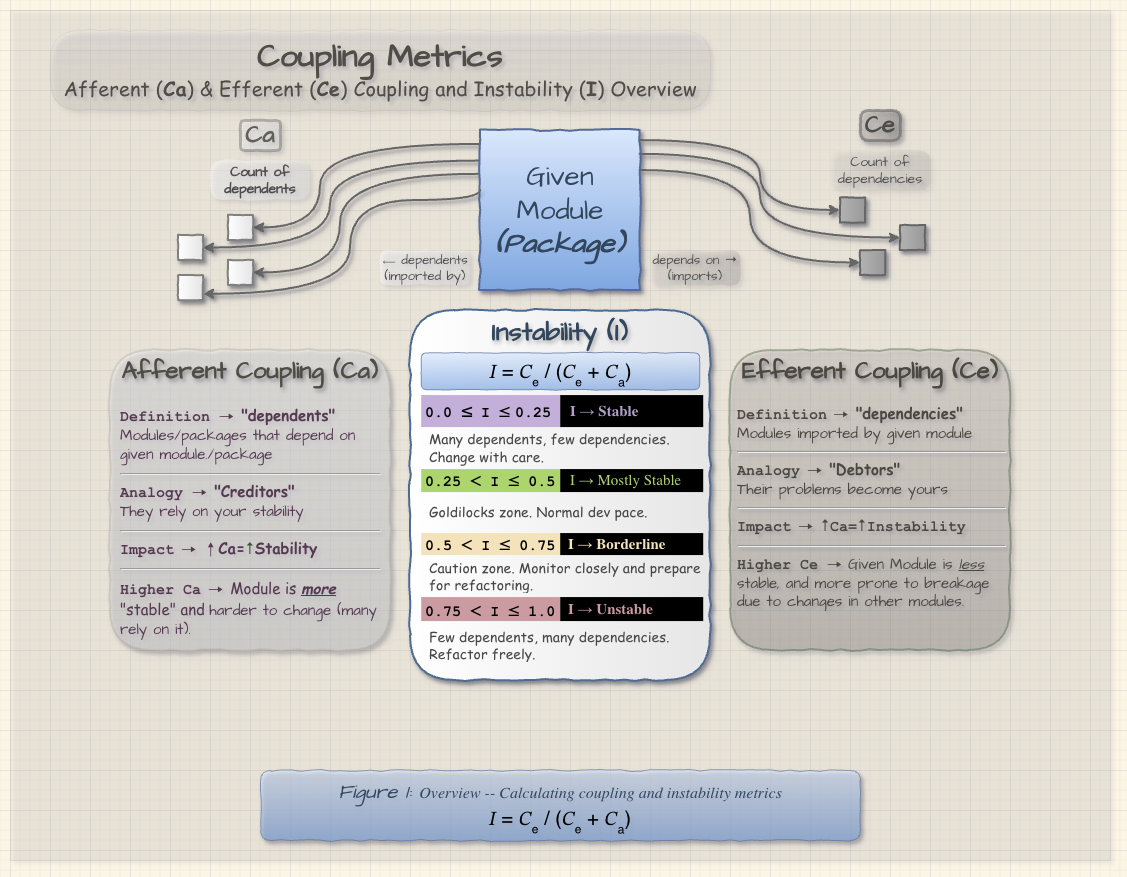
           𝐶ₐ (# of dependents)
           ▲
           ║
           📦 GIVEN MODULE/PACKAGE
           ║
           ▼
           𝐶ₑ (# of dependencies)
Nearly every structural coupling metric derives from two simple counts:
𝐶ₐ(Afferent coupling): Count of modules dependent on a given one𝐶ₑ(Efferent coupling): Count of modules a given one depends on
💨 𝐶ₐ (Afferent Coupling)
𝐶ₐ = number of external modules/packages dependent on a given one
- Afferent coupling measures responsibility
- If many modules depend on a given module, its stability matters 💧
- Break this module, and others break too ⛓️
- Modules with high
𝐶ₐbecome structural anchors ⚓
🌬 𝐶ₑ (Efferent Coupling)
𝐶ₑ = number of external modules/packages upon which a given one depends
- Efferent coupling measures vulnerability.
- The more dependencies you have (
𝐶ₑ), the more ways your code can break. - Every dependency introduces:
- version risk
- semantic assumptions
- upgrade friction
Dependencies are powerful.
But they are never free.
🧮 A Simple Analogy
These metrics behave like a financial balance sheet.
| Metric | Analogy |
|---|---|
𝐶ₐ (Afferent Coupling) |
Creditors (who depends on you) |
𝐶ₑ (Efferent Coupling) |
Debts (who you depend on) |
- Modules with many creditors must be stable.
- Modules with many debts are inherently fragile.
💦 The Instability Index (I)
From 𝐶ₐ and 𝐶ₑ we derive a powerful ratio:
𝐼 = 𝐶ₑ / (𝐶ₑ + 𝐶ₐ)
Instability ranges from 0 to 1
| I Range | Stability | Meaning | Change Strategy |
|---|---|---|---|
0.0 ≤ I < 0.25 |
Stable | Many dependents, few dependencies | Change with care |
0.25 ≤ I < 0.50 |
Balanced | Healthy structural position | Normal dev pace |
0.50 ≤ I < 0.75 |
Borderline | Dependency heavy | Monitor closely |
0.75 ≤ I ≤ 1.0 |
Unstable | Few dependents, many dependencies | Refactor freely |
📈 Instability Curves
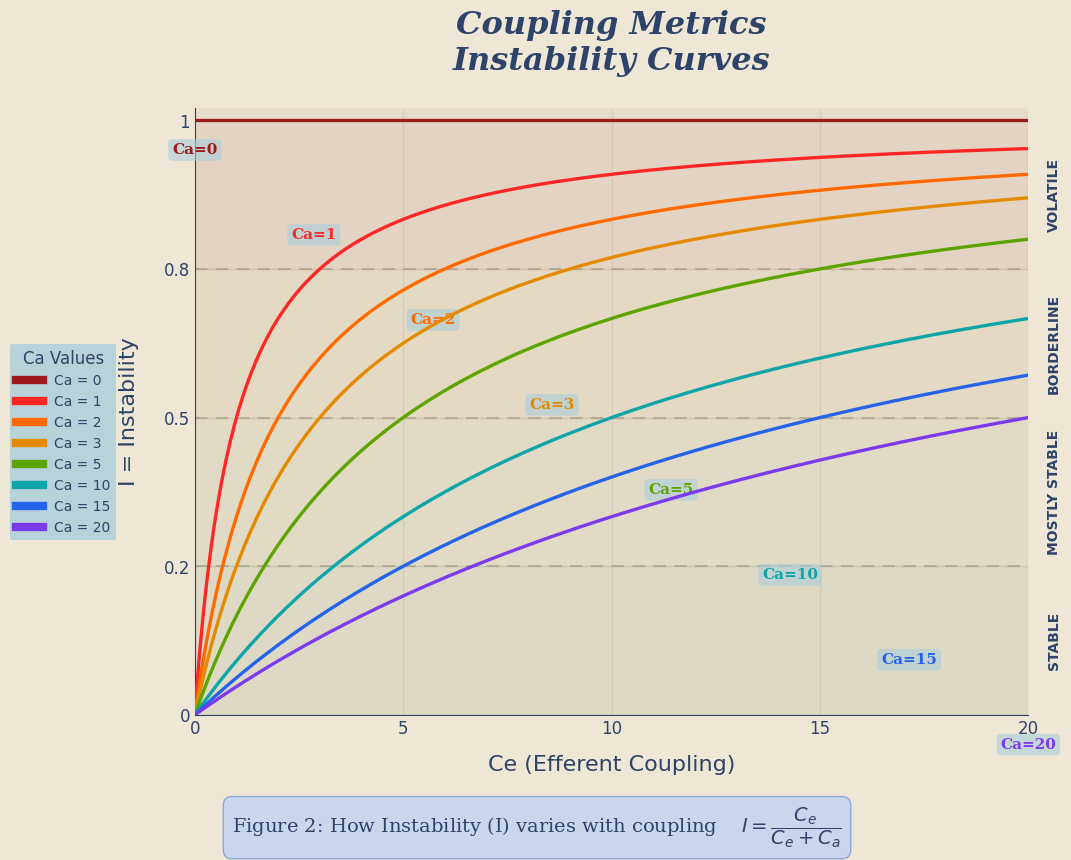
The chart above shows how Instability changes as 𝐶ₑ grows for several fixed values of 𝐶ₐ.
A few patterns jump out immediately:
- When
𝐶ₐis lower,Instabilityrises very quickly toward volatility. Modules with few dependents become volatile with even a modest increase in outgoing dependencies. - When
𝐶ₐis higher, the curve climbs more slowly. A module with many dependents can absorb some additional dependencies before drifting into the more unstable bands. - The
𝐶ₐ = 0line is the extreme case. A module with no dependents is structurally free to become maximally unstable.
This is why 𝐶ₑ is not the whole story by itself.
The same number of outgoing dependencies means something different depending on how much responsibility the module already carries.
Said another way: Instability is not merely about how much you depend on — it is about that dependency load relative to who depends on you.
This leads to one of the most important architectural principles.
Stable Dependencies Principle
Dependencies should flow toward stability 💧.
unstable modules → stable modules
When stable modules depend on unstable ones, architectural fragility appears quickly.
🌐 A (The Abstractness Index)
This metric differentiates types as concrete or abstract (interface/protocol/port).
A = Na / Nc
📏 Variables
Na= number of abstract typesNc= total number of typesA= Abstractness Index
🔬 Interpretation
A = 0→ completely concrete; no abstraction0 < A < 1→ mix of abstract and concreteA = 1→ completely abstract
🗝 Key Takeaways (A)
- Abstraction provides flexibility
- Concrete code provides behavior
- Good architecture balances both
🧬 Main Sequence
When plotting Abstractness (A) against Instability (I), something interesting appears.
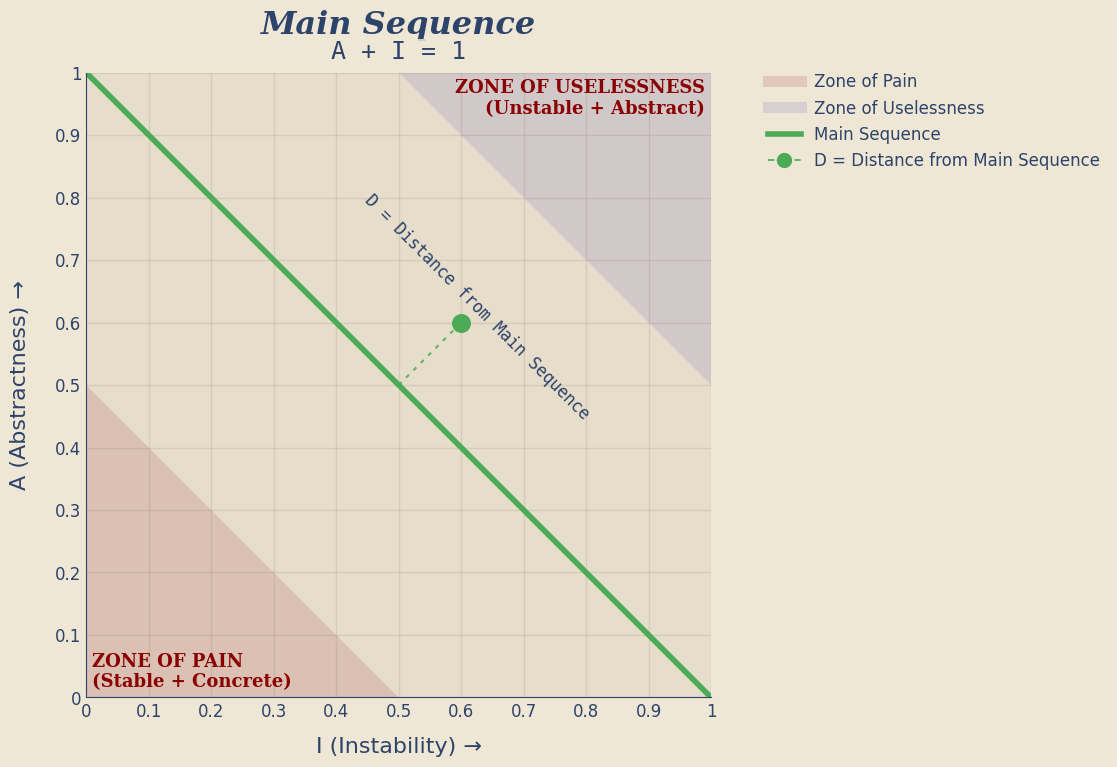
Healthy modules tend to cluster along a line defined by:
A + I = 1
This line is called the Main Sequence.
The conceptual graph below shows the terrain first:
- the main-sequence line itself
- the Zone of Pain in the lower-left
- the Zone of Uselessness in the upper-right
- a small illustrative distance marker showing how we measure deviation from the line
The key idea is simple: modules do not have to sit exactly on the main sequence, but the farther they drift from it, the more likely they are to be structurally imbalanced.
🪨 Architectural Danger Zones
🏦 Zone of Pain
low A
low I
Meaning: concrete AND stable
These modules are depended on by many other modules but contain little abstraction.
Examples often include:
- database schemas
- configuration systems
- foundational libraries
Changing them causes cascading impact, hence the name.
🤷♂️ Zone of Uselessness
high A
high I
Meaning: abstract AND unstable
These modules contain abstractions nobody uses.
Example:
12 interfaces
1 implementation
0 dependents
- Beautiful architecture.
- No real purpose.
📏 Distance From the Main Sequence
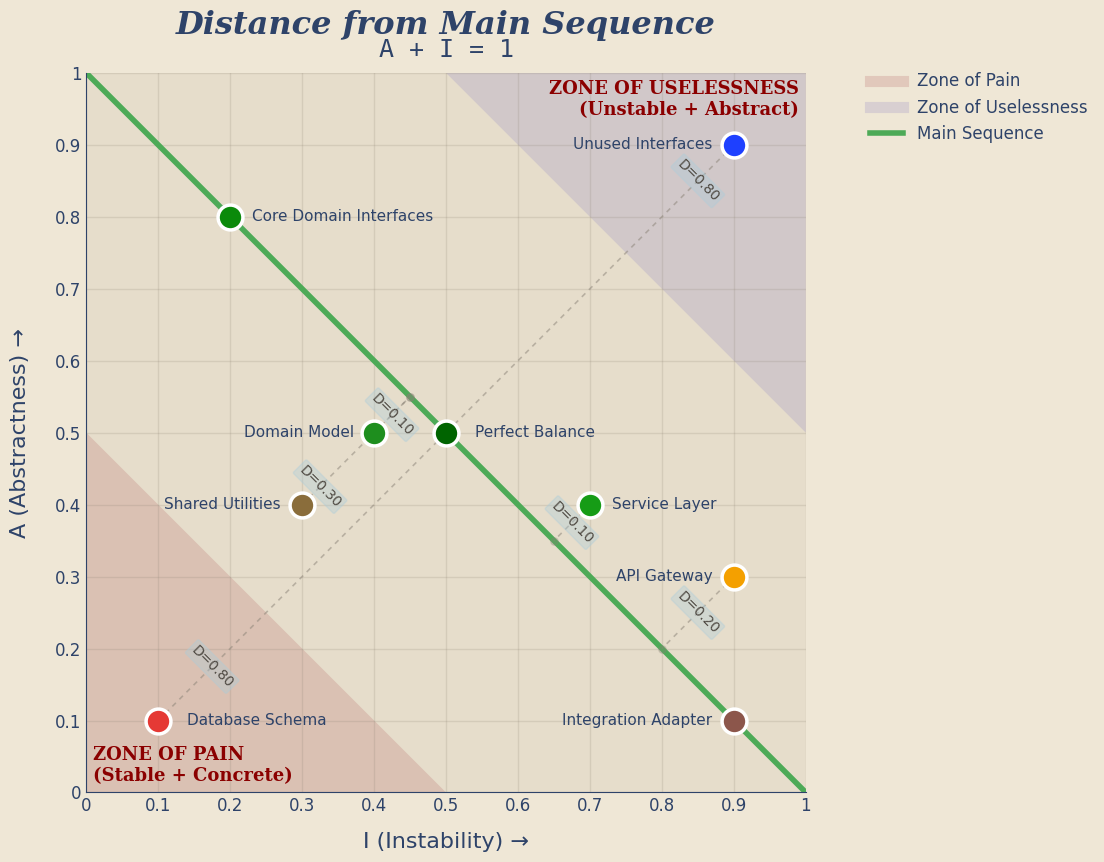
Once we place real modules on the same chart, the picture gets richer.
D = |A + I − 1|
The detailed graph below shows:
- the main sequence
- the two architectural danger zones
- example modules in and out of those zones
- a dotted guideline from each module to its nearest point on the main sequence
- the distance value (
D) for the more interesting examples
That lets us see not just where a module sits, but how far off-balance it is.
Some modules live outside the danger zones and are still worth watching. A service layer, API gateway, or shared utility package may not be pathological, but a non-zero distance still suggests the design is drifting away from the ideal balance.
🗺️ Where These Metrics Apply
These metrics apply to almost any software system:
- microservices
- modular applications
- large monoliths (UI and/or service)
- plugin architectures
-
libraries
- Microservice systems especially benefit from coupling analysis because dependencies often hide behind network calls rather than imports.
- A service with high efferent coupling may rely on many downstream services.
- Each dependency increases operational risk.
- Understanding coupling helps prevent systems from drifting towards chaos and its high cost.
🗝 Key Takeaways
- Architecture is often treated as an art 🖼.
- But beneath the diagrams lies an entire universe 🪐, with its own strange set of rules 🧬.
- Software systems obey structural forces 🧲.
⛓️ Coupling is one of them, and like magnetism and gravity, they cannot be ignored.
📚 References
- Martin, R. C. (1994). OO Design Quality Metrics: An Analysis of Dependencies.
- Martin, R. C. (2017). Clean Architecture.
- Lakos, J. (1996). Large-Scale C++ Software Design.
- Ford, N., Parsons, R., & Kua, P. (2017). Building Evolutionary Architectures.